riding
Training with brains, not reins
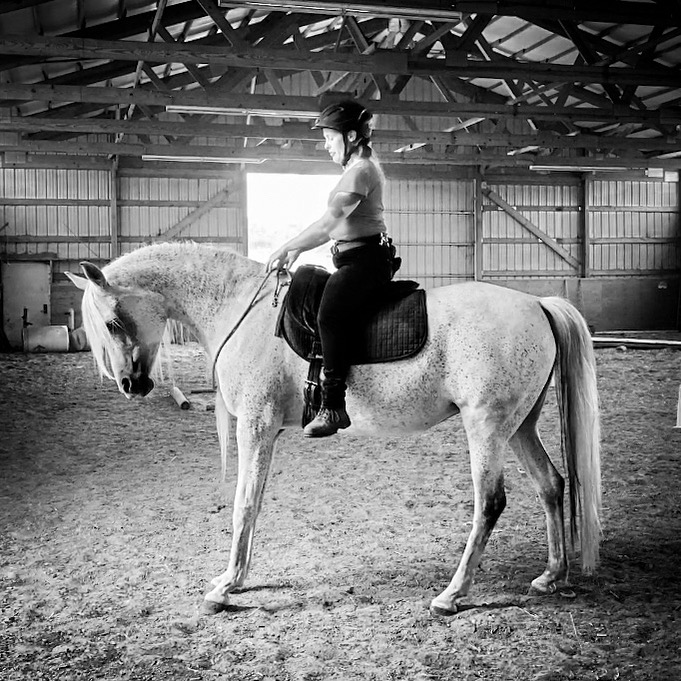
This approach to riding is a departure from tradition but can live right alongside it.
I use positive reinforcement and transition to tactile cues when appropriate. It's not performance oriented, but experiential in that it focuses on your and your horse’s experience as expressed through techniques, but not a focus on technique itself. It's meant to:
- Foster confidence and enjoyment for both horse and human
- Increase feel (timing, mechanics, and use of repertoire)
- Develop proprioception
- Start or restart horses, or problem-solve issues
- Explore what’s possible when the horse has a cooperative role
Though not common in the performance arena, this approach can deepen any riding experience, regardless of level or discipline.
Cooperative saddling
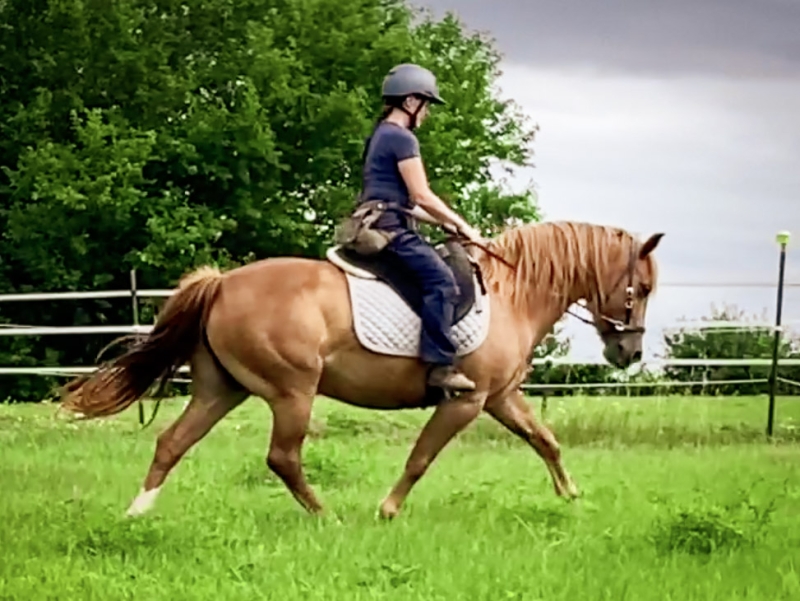
A horse's response to saddling gives us so much information about their experience and level of comfort with being ridden. Framing the process of saddling as a question gives the horse an opportunity to make a choice about whether they'd like to participate. If they choose not to, it's an indication that they're feeling pain or discomfort somewhere, which might be something to investigate before it becomes a bigger problem. One would think that, given the choice, horses would refuse all the time and no one would ever ride again. However, the more you offer the opportunity to say "no," the more likely it is a horse will say "yes."
Ideokinesis
Loosely defined as “Imagery as related to movement,” it's based on the idea that thinking about something and experiencing it are the same in the mind/body. Combining breathing, visualization, metaphor, and movement can help you create a more whole-body-organization effect, rather than manipulating individual physical body parts to try to construct and maintain a static riding position. It's a “back door” to developing proprioception and an entry point to "feel."
The quality of sensory feedback equals the quality of motor output. This "smallwork" develops the skill of attending to sensory input, which is a necessary component of feel. This is qualitative, not quantitative. It's about the experience itself, not how much you can get done. In the beginning, you're not trying to influence immediately, just listening to your body as well as listening for feedback from the horse. The changes happen subtly by changing your perspective.
Click here for more information on ideokinesis and how it works.
Bitless and/or bridleless
When the horse moves in nature without a person, there is nothing in the mouth. Although the esophagus and trachea do connect further down the horse’s throat, a horse does not breathe through the mouth. The horse is an obligate nasal breather. The lips form a closed seal that ensures air moves only through the nasal passages. Breaking the seal (with a bit) changes how the horse breathes, how efficiently they process oxygen, and ultimately how they move.
Bridles in general (bitless, too), also change the way a horse moves (obviously, or we wouldn’t use them). It’s possible for a horse to look successful on the outside, but be contorted on the inside. As much as we can feel from the horse, and as skillful as we are, we can never know better than the horse how to move their own body in a given situation. There is too much variation; on the cellular level, epigenetic changes, individual horse kinematics, breed and inherited characteristics, pre- and post-natal experiences and environment, early socialization, handling, and training, injuries and illness, etc. No human can ever know exactly what the horse is experiencing well enough to make truly appropriate changes by direct manipulation of the horse's body parts.
In particular, there’s nothing about a bridle that the horse innately understands. It all has to be taught, which means you don’t need a bridle to teach a horse rein cues, even for complex movements. Cues for turning, stopping, bending, and lateral work can be given by the seat and legs of the rider, allowing the horse the freedom they should have to truly, by definition, be in self carriage.
It's because of these things that I choose to work with my own horses this way, however I don't require clients to be bitless.
Dressage in the wild
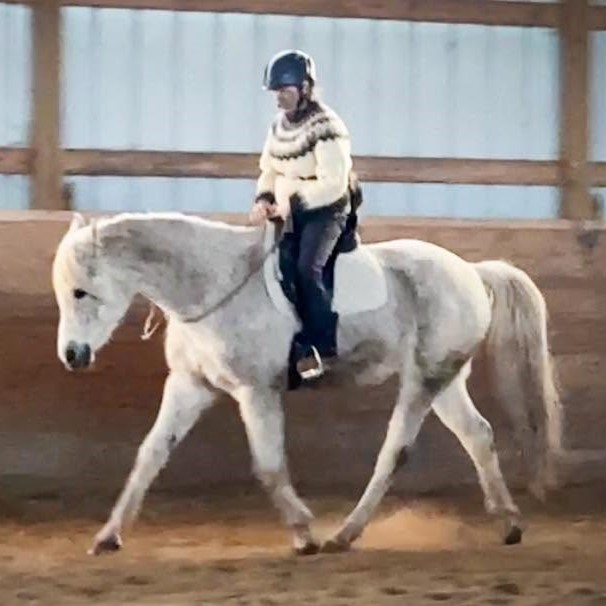
To me, this means approaching a dressage mentality with a tendency to emphasize fluidity and adaptability over prescription. Also working outside using terrain and obstacles as natural variables for better movement capability and capacity.
Do you have questions?
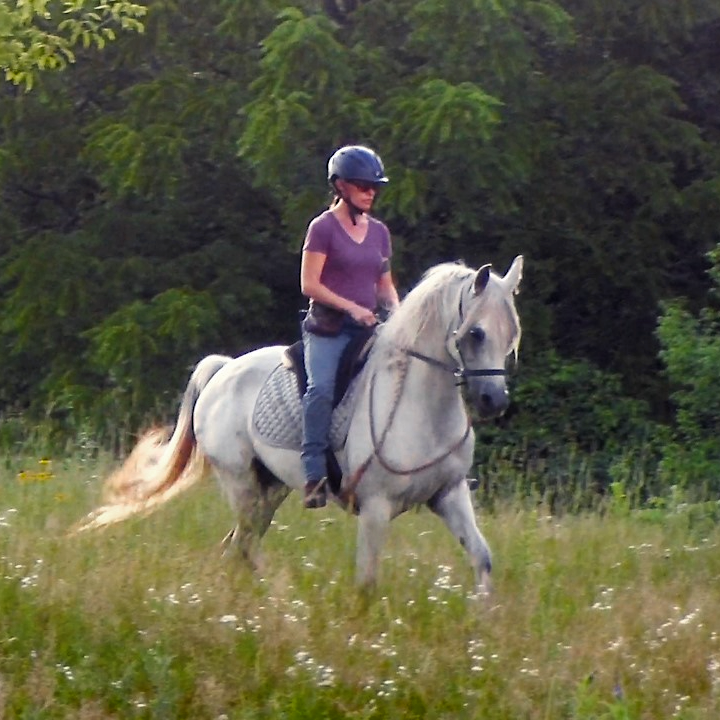
While there’s a structure to learning and to positive reinforcement, there’s no single path to success. Every horse is different, and a lot of horses (and people!) are different on different days. Let me help you make a fun, flexible training plan that celebrates your and your horse’s individuality.
Heather K McManamy
South Central WI
Text welcome at 608-333-6950